Holy Communion Nourishes Your Supernatural Life
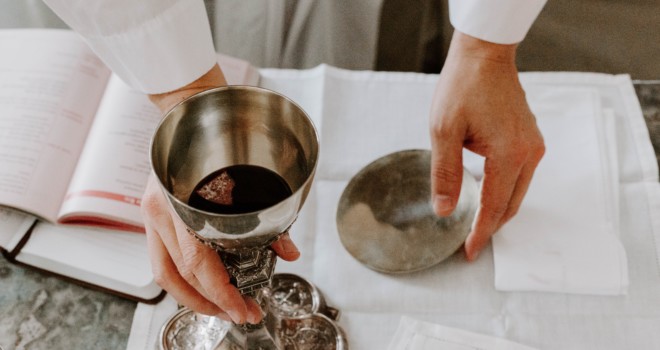
Holy Communion preserves and increases the supernatural life of your soul. In the Holy Eucharist, Christ becomes present so that He may abide bodily among us by His Real Presence in our tabernacles, renew the Sacrifice of Calvary in an unbloody manner on our altars, and nourish our souls in Holy Communion.
The Eucharist is not only a sacrifice, but a sacrament as well. As a sacrifice, it relates in the first instance to God; as a sacrament, to ourselves. Through the Blessed Sacrament God bestows upon us the grace by which we obtain supernatural life and are saved.
By the imparting of divine grace, God has made it possible for us to share His own nature and His own vital activity. The life of God calls for appropriate food. The Bread of Angels has become, through transubstantiation, the food of man. This Bread, the product of our Savior’s love and power, is the only food that is worthy of the Father who gives it and the adopted children who receive it from His hands. It produces wondrous effects in those children. The first and principal effect is that it gives divine life to the soul.
Holy Communion is the Body of Jesus under the form of bread, received as food. With His Body, He gives also His Soul, His divinity, His merits, and His grace. All that He is, all that He has, He makes your own. No being on earth is richer and more honored than you are when you bear in your heart your God and Savior. You could not ask for more. Christ could not give you more.
Because Jesus Christ Himself is the very essence of this sacrament, it follows that the Holy Eucharist is the most sublime and greatest of all sacraments, not only in dignity but also in power. Holy Communion is the most intimate union of ourselves with Christ, and therefore it must excel all other sacraments in power to sustain and increase the supernatural life within us. It is justly called the Blessed Sacrament.
Through the Eucharist, you share in the life of God
God is the source of life. From all eternity the Father gives Himself to the Son. Together the Father and the Son give themselves to the Holy Spirit, sharing with Him Their one divinity.
The eternal Son of God, in His limitless love for our fallen race, became incarnate that men might have life, and might have it more abundantly. At the time of the Incarnation, most of the children of Adam had ceased to live the supernatural life and had devoted themselves to the pursuit of vain honors, deceitful riches, and sinful pleasures. They had ceased to recognize the glorious dignity to which they were called — that of children of God — and had sunk to the lowest depths of sin.
The only-begotten Son of God then condescended to become man so that He might raise man to God. He descended to the depths of humiliation so that He might raise man to a most exalted dignity, to the sharing of God’s own life. It was not enough for Him to offer to God’s offended majesty that atonement which only a divine Person could adequately pay and to merit for man the supernatural life Adam had forfeited, but in His undying love for men, Jesus bequeathed to us a marvelous gift that was to feed and foster the supernatural life within our souls, adorn them with holiness, and thus perfect us more and more in our glorious dignity of divine sonship. This wondrous gift is the living Flesh and Blood of the Word Incarnate, substantially present in the consecrated Host.
The reception of the Blessed Sacrament is of supreme importance to every soul Christ has redeemed. According as that heavenly banquet is rightly partaken of, or neglected, man will enjoy throughout eternity the fulfillment of the supernatural life in the Beatific Vision of God, or will be excluded from Him.
God wants to give you a share in His divine life. Before doing so, however, He gave His life in all its fullness to the sacred humanity of Jesus because of its union with the second Person of the Blessed Trinity. This divine life then extends from Christ, the Head, into the Body of the Church. The members of this Body are the faithful who in turn share in that intimate life of the three Divine Persons.
Christ is the Mediator through whom grace comes to all men. By His sacrifice on the Cross, He has merited this divine life that mankind had lost by sinning. Jesus gives you His divine life and unites you with God through the sacraments, especially in Holy Communion, for it is the sacrament of union.
St. Augustine prays, “Other priests offered for themselves and for their people; this Priest, not having sin that He should offer for Himself, offered Himself for the whole world, and by His own Blood entered into the holy place. He, then, is the new Priest and the new Victim, not of the law but above the law, the universal Advocate.”
The Bread of Life is food for your soul
The first effect of Holy Communion is life. All the sacraments either impart supernatural life to the soul or develop it in the soul where it is already found. They do this for certain purposes. For instance, the sacrament of Penance raises the soul from death to life; Confirmation bestows on it a special strength to fight against its external enemies. But the Eucharist is concerned with the supernatural life itself. Its function is to intensify and strengthen that life. St. Thomas writes, “We should consider the effects of the Eucharist with regard to the manner in which the sacrament is conferred, as it is given in the form of food and drink: thus all the effects that material food and drink produce for the corporal life — that is, to sustain, to cause growth, to repair loss, and to delight — this sacrament produces them also for the spiritual life.”
Holy Communion is a sacrament, and hence, like all the other sacraments, it is a sign instituted by Christ to give grace. Like all the other sacraments, Holy Communion also is designed to give that precise grace of which it is a sign. Baptism, for example, is a symbolic bath; it contains and confers the grace of spiritual cleansing from sin. Confirmation is an anointing; it brings with it the grace of spiritual maturity. It makes its recipient firm in the Faith, anointed for the spiritual battle like an athlete of old.
Holy Communion is a sign of nourishment; hence, it is meant to bring to the soul the graces of spiritual nourishment. Holy Communion is meant to do for the soul what material food does for the body, and that is to preserve life and protect it. Material food enables you to continue living and protects you from fatal disease; Holy Communion preserves the spiritual life of your soul and protects you from the spiritual disease of mortal sin.
In His discourse after the multiplication of the loaves, Jesus stresses this fact five times. “I am the living Bread which came down from Heaven; if any one eats of this Bread, he will live forever; and the Bread which I shall give for the life of the world is my Flesh. . . . Unless you eat the Flesh of the Son of Man and drink his Blood, you have no life in you; he who eats my Flesh and drinks my Blood has eternal life, and I will raise him up at the last day.” The sharing of divine life means that God lives in you and you in Him, and that as God the Son has by nature the same life as the Father in its infinite fullness, so you share it by grace.
Our Lord compared the Most Holy Sacrament of the Altar with the manna given to the Jews, because the Holy Eucharist was intended to be the daily spiritual food of Christians, just as manna had been the daily food of the Israelites in the desert.
Manna is like the eucharistic Bread, the Body and Blood of our Lord, which comes from Heaven to feed our souls during our life on earth, until we arrive at last in Heaven, our eternal home, the land of promise. Jesus said, “I am the Bread of Life. Your fathers ate the manna in the wilderness, and they died. This is the Bread which comes down from Heaven, that a man may eat of it and not die.”
It is in the midst of a meal, under the form of food, that Jesus chose to institute the Eucharist. He gives Himself to you as the nourishment of your soul: “My Flesh is food indeed, and my Blood is drink indeed.” In the Our Father, he taught us to say, “Give us this day our daily bread.” This refers to Holy Communion. Like the manna, the Eucharist is bread come down from Heaven to give life by nourishing grace within your soul. The life of your soul is supported and developed by eating the “Bread of Life,” much in the same way as the life of your body is supported by eating your ordinary meals. Just as it is necessary to supply your body with food every day, so you must nourish and feed your soul, since obviously the soul has no less need of spiritual nourishment than the body has of material nourishment.
Jesus has prepared for you this great feast of the Holy Eucharist — the food of the soul. If you receive Communion only seldom, you become a prey to temptation and sin, and, growing weaker spiritually, you may fall into mortal sin. Many Catholics have good health and are blessed with the material goods of this world. They are very much alive physically, but are dead spiritually.
Therefore, Jesus comes not only to visit you in Holy Communion, but to be the food of your soul, that receiving Him you may have life — the life of grace here below, the life of glory hereafter.

✠
This article is adapted from a chapter in Fr. Lovasik’s The Basic Book of the Eucharist. It is available as a paperback or ebook from your favorite bookstore and online at Sophia Institute Press.
Photo by Annie Theby on Unsplash


