Wednesday, December 9, 2015

Dispelling the ‘Few Extremists’ Myth – the Muslim World Is Overcome with Hate

Dispelling the ‘Few Extremists’ Myth – the Muslim World Is Overcome with Hate

It is simply false to declare that jihadists represent the “tiny few extremists” who sully the reputation of an otherwise peace-loving and tolerant Muslim faith. In reality, the truth is far more troubling — that jihadists represent the natural and inevitable outgrowth of a faith that is given over to hate on a massive scale, with hundreds of millions of believers holding views that Americans would rightly find revolting. Not all Muslims are hateful, of course, but so many are that it’s not remotely surprising that the world is wracked by wave after wave of jihadist violence.
To understand the Muslim edifice of hate, imagine it as a pyramid — with broadly-shared bigotry at the bottom, followed by stair steps of escalating radicalism — culminating in jihadist armies that in some instances represent a greater share of their respective populations than does the active-duty military in the United States.
The base of the pyramid, the most broadly held hatred in the Islamic world, is anti-Semitism, with staggering numbers of Muslims expressing anti-Jewish views. In 2014, the Anti-Defamation League released the results of polling 53,100 people in 102 countries for evidence of anti-Semitic attitudes and beliefs. The numbers from the majority-Muslim world are difficult to believe for those steeped in politically correct rhetoric about Islam. A full 74 percent of North African and Middle Eastern residents registered anti-Semitic beliefs, including 92 percent of Iraqis, a whopping 69 percent of relatively secular Turks, and 74 percent of Saudis.
The trend toward Muslim anti-Semitism continues even when Muslim nations are far removed from the Arab–Israeli conflict. A solid majority — 61 percent — of majority-Muslim Malays harbor anti-Semitic attitudes, while only 13 percent of neighboring majority-Buddhist Thais are anti-Jewish.
The next level of the pyramid is Muslim commitment to deadly Islamic supremacy. In multiple Muslim nations, overwhelming majorities of Muslims support the death penalty for apostasy or blasphemy. Collectively, this means that hundreds of millions of men and women support capital punishment for the exercise of the basic human rights of freedom of expression and free exercise of religion:
Moving beyond Islamic supremacy to the next step of the pyramid, enormous numbers of Muslims are terrorist sympathizers. It is still stunning to see how popular Osama bin Laden was early last decade, and even as his popularity plunged (as he grew weaker and more isolated), his public approval remained disturbingly high:
But what about ISIS — the world’s most savage and deadly terror organization? The latest polling data show that while a majority of Muslims reject ISIS, extrapolating from the populations of polled countries alone shows that roughly 50 million people express sympathy for a terrorist army that burns prisoners alive, throws gay men from buildings, and beheads political opponents. In Pakistan a horrifying 72 percent couldn’t bring themselves to express an unfavorable view of ISIS:
But sympathy for terror is different from active support, and here’s where the numbers are difficult to pin down. I know of no reliable database that shows how many Muslims give to jihadist charities, spread jihadist propaganda on social media, support radical preachers, or otherwise take concrete actions to advance the terrorists’ cause. We do know, for example, that anti-Israel terrorism is so popular in Saudi Arabia that a telethon once raised $100 million to support the 2002 intifada. Shows of support included this charming scene:
A 6-year-old boy, with a plastic gun slung over his shoulder and fake explosives strapped around his waist, walked into a donation center and made a symbolic donation of plastic explosives, according to Al Watan daily.
It is from this fertile soil that jihadists grow. And here the numbers decisively belie the “few extremists” rhetoric. In Iran alone, the Revolutionary Guard represents a proportionate share of the population similar to the combined strength of the active-duty Army and Marines here in the United States. Between Boko Haram, the Al-Nusra front, ISIS, Hezbollah, Hamas, al-Qaeda, the Taliban, Yemeni militias, Libyan militias, and many others, the number of active jihadists numbers in the hundreds of thousands; some estimates indicate that 100,000 are fighting in Syria alone.
To give a sense of proportion, the United States is a nation that honors military service, respects its veterans, and engages in a massive military recruiting effort that includes offering soldiers generous salaries, pensions, benefits, and the best military equipment in the world. Even then, only about 0.4 percent of the American population engages in active-duty military service at any given time.
In Britain, more Muslims join ISIS than join the British army.
Jihadists, by contrast, have low life expectancies, second-rate gear, low salaries, and often have to break domestic laws and journey across battlefields to join terrorist insurgencies, but still they join. In Britain, for example, more Muslims join ISIS than join the British army.
Simply put, America’s leaders actively deceive the American people about the sheer scale of Muslim hatred and commitment to jihad. Rather than tell us the truth, the Obama administration and the media aristocracy constantly lecture Americans about discrimination, apparently believing that only their scolding keeps the great redneck masses at bay.
Telling us the truth won’t send Americans on an anti-Muslim killing spree. Instead, it will make us no more radical than Egypt’s president, who briefly made headlines earlier this year after calling for a “revolution” in Islam and decrying faith traditions that he admitted had been “sacralized over the centuries.” Telling the truth can demonstrate the scale of the problem and at least begin the process of convincing the American people that there is no quick fix, that the defense of the nation will require courage and resolve over the long term.
Islam has a problem. It is Muslims’ responsibility to reform their own faith. It is America’s responsibility to defend itself and its citizens. Neither goal is advanced by telling convenient, politically correct lies. After 14 years of war, can we finally tell the truth?http://www.nationalreview.com/article/428146/more-than-few-islamic-extremists
— David French is a staff writer at National Review, an attorney, and a veteran of Operation Iraqi Freedom.

Friday, December 4, 2015

FBI Counterterrorism Agent: ‘Vast Majority’ of US Mosques/Islamic Centers Part of ‘Jihadi Network’

Breitbart News Daily: Fmr. FBI Counterterrorism Agent: ‘Vast Majority’ of US Mosques/Islamic Centers Part of ‘Jihadi Network’

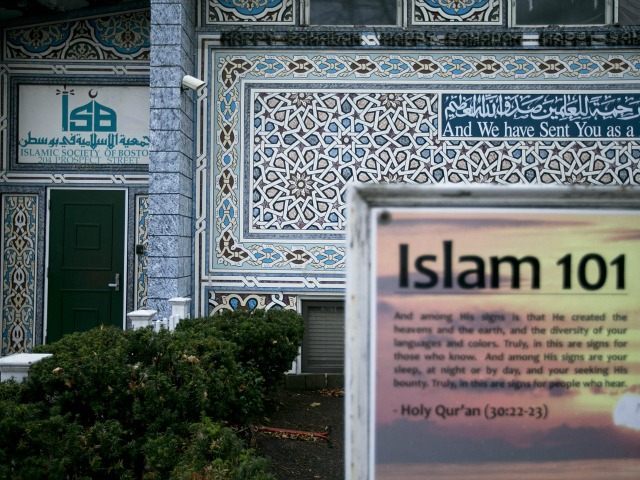
Islamic Center YOON S. BYUN/Boston Globe
Guandolo told host and Breitbart News Executive Chairman Stephen K. Bannon that the San Bernardino terrorist, the UC Merced stabber, the Chattanooga shooter, and the Boston Bombers can all be traced back to such Islamic Centers where “they were supported and trained.”

Guandolo said that the San Bernardino terrorists attended the Islamic Center of Riverside, which he said was a “a Muslim Brotherhood Center.” He noted that the Boston Bombers attended the Islamic Society of Boston, which he said was a subsidiary of the Islamic Society of North America that was founded by an al-Qaeda guy who used to advise former President Bill Clinton and former Vice President Al Gore and is now in prison.

He said there are over 2,200 Islamic Centers and mosques in America and the “vast majority of them are a part of this network — they’re hostile.”
He said “over 75%” of these centers, based on their property records, are a part of the “Muslim Brotherhood network” since they are “owned by the North American Islamic Trust, which is the bank for the Muslim Brotherhood here.”
He said “in 2006, I put together the first training program inside the government on the jihadi network in the United States… and was able to sneak a second one in in early 2007.”

Guandolo trained “quite a number of agents from a variety of agencies,” including the Department of Justice, before the government shut down the programs. He mentioned that the “most prominent Muslim Brotherhood Organizations like the Islamic Society of North America, Muslim Public Affairs Council, and the Hamas organization called the Council on American Islamic Relations (CAIR) — complained to the White House about the training inside the government at the FBI.”

Guandolo said he “came to understand very deeply the massive jihadi network we have in the United States” and discovered that “the leaders of the Islamic organizations… were actually interfacing with government leaders and advising them with how to proceed in the war on terror, as it was called.”
Guandolo realized that “we were being advised by the enemy on how to investigate and deal with the enemy” and “and that’s why I started the training.”
He mentioned that in the U.S. v. Holy Land Foundation case in 2008, a 15-year FBI investigation that was revealed demonstrated “that the most prominent Islamic organizations in America and North America are a part of the Muslim Brotherhood, Hamas, the jihadi network here.” Guandolo said that “internal documents entered into evidence say that the purpose of this network is to wage civilization jihad… until the entire world, and specifically the United States, is under Sharia law and the Islamic State is established here.”

He said that, for instance, the “Islamic Society of North America (ISNA)—the largest Muslim Brotherhood organization here— is a Hamas funding entity” and its leadership works with the Secretary of State and the National Security staff, the previous four Secretaries of State, and briefs the FBI and CIA. He mentioned that the previous president of ISNA Mohamed Magid works “very closely with the White House and sits on the Homeland Security Advisory Committee with a secret clearance.”
Guandolo emphasized that these Muslim leaders are the ones that are working with the FBI, Pentagon, Department of Homeland Security, National Security staffs.
“Look at our policy for domestic terrorism… and you can track it back to these organizations,” he said, adding that “they write policy” and say “look, this is offensive to Muslims and this is how you need to do it, and we have done it.”
Guandolo said that it is “insane” that these leaders serve a liaisons “between the Muslim community and the U.S. Government.”

“This is the kind of operation these guys are doing here,” he said.
Saying that he only speaks “with what I would walk into a court of law with” because there is “no issue with the amount of evidence” on the matter, Guandolo said the objective of the jihadi network is to “to establish an Islamic State under Sharia.” For instance, he said the Muslim Brotherhood’s own bylaws in English explicitly state that “they must fight the tyrants and enemies of Allah.”
He also said the one of the biggest mistakes in dealing with Islamic terrorism is that “we want to tie it to ISIS” or another group when this is “part of a much broader movement” and more “than one organization.”

“That network is not being touched,” he said. “That network in Paris that supported that attack is not being touched.”

More troubling, according to Guandolo, is that many authorities in the federal government are oblivious to the Jihadi network.

He said during one of his training sessions, someone who had been in the FBI and counterterrorism for over 14 years and was so angry that he “had never heard of the information you are putting out here.” When he asked others in audience from the FBI, Department of Homeland Security and other government agencies to “raise your hand if you knew this… zero hands went up.”

“That right there is the issue,” he said, adding that he has even briefed three- and four-star generals who had also been clueless. “They don’t know it.”
Guandolo said that even senior government officials have “no idea this is going on inside the United States because the people advising us are the leaders of the organizations—that per evidence in counterterrorism trials—have been identified organizations that are Muslim Brotherhood, Hamas, al-Qaeda” who are “necessarily hostile to our system, our war fighting, our way of life. That’s the problem.”
Guandolo runs the understandingthethreat.com site and is the author of Raising a Jihadi Generation
Listen to the interview below:

Wednesday, December 2, 2015

Medina—The First Muslim Refugee Resettlement Program

Medina—The First Muslim Refugee Resettlement Program

paris_111615
With all the talk about the Syrian refugees, one point is often overlooked. Much of the debate focuses on the question of whether or not the refugees can be reliably vetted. If they can be certified as one hundred percent terrorist-free, then, presumably, the resettlement can safely proceed.
But even if every terrorist could be excluded from the ranks of the refugees, a problem would remain. Many analysts are concerned that the resettlement program might facilitate the growth of terrorist-tolerant communities in America. By “terrorist-tolerant” I don’t mean that its members are thinking every minute about what they can do to support jihad, but rather that they have come to take for granted things that aren’t assumed in other societies.
Terror, for instance. Nonie Darwish, a former Muslim who grew up in Egypt, puts it this way:
One of the reasons that the so-called moderate Muslims have become irrelevant … is that over the centuries they have become tolerant of Islamic terrorism and considered it as part of normal life.
“Life under Sharia itself is a life under terror,” observes Darwish. And that daily low-level terrorism accustoms Muslims to view it as something “like a natural disaster or part of life that must be tolerated.”
So, although a Syrian refugee may have no personal taste for terror, he can be surprisingly tolerant of it. A 2007 public opinion poll of Syrians revealed that 75 percent of those polled supported financial aid for Hamas, Islamic Jihad, Hezbollah, and “Iraqi fighters” (at that time, mostly al-Qaeda). Need it be mentioned that all these groups are designated as terrorist organizations by the U.S. government? A more recent poll of 1,365 Syrians found that one out of five considered ISIS to be a positive influence on the country. And living in the West doesn’t seem to change these attitudes. A 2014 opinion poll showed that 27 percent of the French population in the 18-24-year-old demographic supported ISIS. Assuming a random sample, and assuming that the majority of pro-ISIS respondents were Muslim, that would mean that the vast majority of young French Muslims support ISIS.

That kind of supportive environment is a factor that’s often overlooked in the debate over Syrian refugees. As defenders of the resettlement program like to point out, terrorists can get into the U.S. by other means than by mingling with refugees. But once here, they need a network to support them and give them cover. And the network itself can only function if the larger community is willing to look the other way.
Europe is now dotted with such networks—in the Paris suburbs, in the Brussels borough of Molenbeek, in the Neukölln district of Berlin, and in numerous other places. There is evidence that similar networks already exist in nascent form in the U.S. Beyond the question of whether terrorists will mix in with refugees lies a larger question about the refugee resettlement program. Will it contribute to a strengthening of our society, or will it lead instead to the strengthening and expansion of terror-supportive networks?
Whether or not a particular group of refugees has been infiltrated by ISIS, there remains the fact that many refugees subscribe to the same general worldview held by members of the Islamic State. After all, they’ve been steeped in the same cultural-religious milieu that produced the terrorists. Many of them will take it for granted that Islam is the supreme religion, that Muhammad was the perfect man, and that Jews and Christians are unclean. They may be averse to committing violence, but they may find it perfectly understandable if other Muslims resort to violence in order to avenge a real or perceived insult to Islam. Although that mindset is alien to us, it shouldn’t be incomprehensible. At the time that a death fatwa was issued against the author Salman Rushdie, I remember talking with several Catholics who felt quite sympathetic to the Ayatollah Khomeini (who issued the fatwa), and rather unsympathetic to Rushdie and his “blasphemous” attitude toward religion.
Given their cultural background, it’s reasonable to expect that Sunni Muslim refugees will bring with them a set of beliefs and attitudes conducive to the incubation of terrorism. Even if there were a foolproof method for excluding active terrorists from their midst, there is no way of vetting for future terrorists—young Muslims who at some point in their development decide that ISIS or some similar movement is the logical conclusion of all they have been taught.
This “conversion” to radical Islam can come quite suddenly. Mohamed Abdelslam, the brother of two of the Paris terrorists, told reporters that his brothers began to change roughly six months before the attack, when they, “stopped drinking and started praying.” Likewise, the radicalization of Mohammod Youssuf Abdulazeez, the Chattanooga jihadist who killed five servicemen, could not easily have been forecast. To his classmates and teachers, he seemed like a normal American boy, and if he had problems, they were of the normal young American male variety—pot-smoking, heavy drinking, and fast driving. Unlike other young Americans, however, he would have been exposed—either at home or on Islamist websites—to the belief that one can wipe out one’s sins by an act of martyrdom.
This “sudden conversion syndrome” to more radical forms of Islam is increasingly common among Muslim youth. But, as I said, it’s not easy to predict. If you’re a government official whose job it is to vet refugees, how can you know if the smiling fourteen-year-old boy standing in front of you and surrounded by his polite and pleasant family is going to go radical three years down the line?
Absent other information and unfair as it may seem, his family’s culture has to be taken into account. To some extent, we are all creatures of our culture, and Islamic cultures seem to produce a disproportionate number of terrorists. Contemporary Western culture, on the other hand, seems to produce a disproportionate number of naïve egocentrics who are incapable of imagining that other cultures may be radically different from their own. Their tendency is to automatically project their own values and attitudes on to all they see.
But, as should now be clear to anyone willing to look, Islamic culture is not simply a colorful variation of our own. In those places where traditional Islam is the governing principle—whether in the Islamic State, or in parts of Pakistan, Indonesia, or Nigeria—the same disdain for non-Muslims and their religions can be found. This attitude is common not just among terrorists, but also among ordinary Muslims. By all accounts, the fifteen Muslim migrants who threw twelve Christians overboard during a Mediterranean crossing were not terrorists, they were simply Muslims who took offense when some of the Christians began to pray. Some of the Muslims who attacked Christians in European refugee camps appear to have been members of ISIS, but others were not. Blind to the differences in culture, European officials initially put Christian and Muslim migrants together in the same camps. With a bit more cultural awareness under their belts, they came to the politically incorrect conclusion that the two groups had to be housed separately. A less violent example of Islamic contempt for other cultures was provided by the Turkish soccer fans who booed and chanted when, during a Turkish-Greek soccer match, a moment of silence was requested for the victims of the Paris massacre.
As concerns the Syrian refugee crisis, Christians are regularly reminded that the Holy Family were once refugees in Egypt. Yes, but the culture brought into the world by the Holy Family is worlds apart from the one introduced six centuries later by Muhammad.
Let’s not forget that the Holy Family were once refugees. But in regard to the present crisis there’s another and perhaps more appropriate analogy to consider: Muhammad and his followers were also once refugees. He and his group of about 100 men, women, and children had long overstayed their welcome in Mecca. According to Muslim chroniclers, they had to flee in order to avoid persecution. Fortunately for Muhammad, the more “enlightened” citizens of Medina extended an invitation to the Muslims to come and live in their city. It is not recorded whether or not they held up large “welcome refugees” banners as is now the custom at European train stations, but they soon enough experienced the kind of regrets that Europeans are now having. Muhammad gradually acquired wealth and converts, and within a half-dozen years he was the master of Medina. Those Medinans who were not exiled or slaughtered were thoroughly subjugated. Muhammad then used Medina as the launching pad for his conquest of all Arabia. Within a century of his death, his followers had conquered nearly half of the civilized world.
The relevant analogy for our society is not the flight to Egypt, but the flight to Medina and the subsequent colonization of that city by the Muslims. A similar process of cultural conquest by migration is now underway in Europe. Citizens of the United States would be well-advised to monitor the situation over there before embarking on their own ill-considered experiment in welcoming the stranger.

William Kilpatrick taught for many years at Boston College. He is the author of several books about cultural and religious issues, including Psychological Seduction; Why Johnny Can’t Tell Right From Wrong; and Christianity, Islam and Atheism: The Struggle for the Soul of the West. His articles have appeared in numerous publications, including Catholic World Report, National Catholic Register, Aleteia, Saint Austin Review, Investor’s Business Daily, and First Things. His work is supported in part by the Shillman Foundation. For more on his work and writings, visit his website, turningpointproject.com

Monday, November 30, 2015

ON THE WAY BACK HOME: Chapter 3 - There Can Be But One, True Religion

ON THE WAY BACK HOME: Chapter 3 - There Can Be But One, True Religion:

Chapter 3 - There Can Be But One, True Religion

But why change one's religion?  Why reenter the Catholic Church?  Isn't one religion as good as another?  The plain answer to this important question is an emphatic, No. This saying for the most part is the work of those who in reality are indifferent to all religion, and make this an excuse for their indifference.  A little reasoning should suffice to prove that one religion is not as good as another religion.  If it were there would have been no need of Christianity in the first place.  For there were other religions existing upon earth at the time Christ established His Church.  There were Confucianism and Buddhism and Judaism and Paganism.  Were one religion as good as another, it would have been sufficient for God to have allowed these religions to function without establishing another.  Christ, however, did establish another.

In His dealings with man, God has always been definite and exact.  After the fall of Adam, God promised that in due time He would send a Redeemer to satisfy for man's sin.  But in order to keep the knowledge of the one, true God among men until that time, God called Abraham to be the father of His chosen people.  Hence he established the Jews as the one true and divinely appointed guardian of His law until He should send the promised Messias.  The Jewish Church, then, was the one, true religion up to the time of Christ.  God Himself then gives the answer to the question, "Is not one religion as good as another?"  He Himself established one religion as the true religion up to the coming of Christ.  Christ in His turn established but one Church, and He proclaimed that that Church would last to the end of time.  "Thou art Peter," He says, "and upon this rock I will build my Church and the gates of Hell shall not prevail against it."  (Matt. 16, 18.)  Christ said "Church" not "Churches", and He meant church, not churches.  And again He says:  "And there shall be one Fold and one Shepherd."


It is evident from many other considerations that there can be but one, true religion.  As there is only one God, there can be but one, true worship of God.  Truth itself is one, and it cannot be contradictory.  At one and the same time, two and two cannot be four and six and nine.  If it were, what confusion would result in the field of mathematics.  In the field of morality, what terrible evils would result if it were equally good and true to murder one's parents and to protect their lives.  Likewise were it equally true that Jesus Christ is the Son of God and not the Son of God, if it were equally true that Baptism is a Sacrament and absolutely necessary for salvation and neither a Sacrament nor necessary for salvation, what doubt, uncertainty and confusion would arise in the minds of Christians.  The disastrous state of division and disunion that exists in the Christian sects outside the Catholic Church today is partly the result of following the theory that one religion is as good as another.  Christ manifestly would not come upon earth to found fifty-seven different churches teaching different doctrines to confuse men's minds.  He came upon earth to found the one true Church that would be the one sure and safe path to salvation. 


Photo: Morning Mass
Location: San Juan Capistrano Mission, San Antonio, Texas, 1945
Photographer:  Alfred Eisenstaedt

Vatican’s liturgy chief contradicts Pope Francis on Communion for non-Catholics

Vatican’s liturgy chief contradicts Pope Francis on Communion for non-Catholics

"A person cannot decide if he is able to receive Communion. He has to have the rule of the Church."
Speaking with Aleteia reporter Diane Montagna, Cardinal Robert Sarah said, “Intercommunion is not permitted between Catholics and non-Catholics. You must confess the Catholic Faith. A non-Catholic cannot receive Communion. That is very, very clear. It’s not a matter of following your conscience.”
In responding to a Lutheran woman seeking to go to communion with her Catholic husband, Pope Francis said, “There are questions that only if one is sincere with oneself and the little theological light one has, must be responded to on one’s own. See for yourself.”  The pope, who was speaking to a Lutheran community in Rome November 15, added that both Lutherans and Catholics believe the Lord is present in Holy Communion, and that while there are “explanations and interpretations” that may differ, “life is bigger than explanations and interpretations.”
Pope Francis concluded it was not within his competence to allow a Lutheran woman to receive Holy Communion with her Catholic husband, but to answer her question, she should, “Talk to the Lord and then go forward.”
But Cardinal Sarah, who serves as prefect of the Congregation for Divine Worship and Discipline of the Sacraments, contradicted this suggestion.  “It’s not that I have to talk to the Lord in order to know if I should go to Communion,” he said. “No, I have to know if I’m in accord with the rule of the Church.
“It’s not a personal desire or a personal dialogue with Jesus that determines if I can receive Communion in the Catholic Church. 
How can I know that the Lord has really said: ‘Come and receive My Body.’ No. A person cannot decide if he is able to receive Communion. He has to have the rule of the Church: i.e., being a Catholic, being in a state of grace, properly married [if married].
The cardinal warned that if Holy Communion is not received correctly it would not be a benefit to unity, but quoting St. Paul he said, “We will eat our condemnation.”
See the full interview at Aleteia here.

Wednesday, November 25, 2015

St. Catherine of Alexandria: A Guide in Our Call as Christian Witnesses

St. Catherine of Alexandria: A Guide in Our Call as Christian Witnesses

St. Catherine of Alexandria: A Guide in Our Call as Christian Witnesses

Today the Church celebrates the feast of St. Catherine of Alexandria. She is the patroness of preachers and philosophers. The reason for this will become quite clear. Tradition tells us that Catherine was born in Alexandria and was the daughter of Constus, who was the governor at the time. She was a studious child and greatly enjoyed learning. She received a vision of the Madonna and Child and converted to Christianity. Persecutions were becoming increasingly more brutal under the emperor Maxentius during her lifetime. Being the daughter of the Governor, she went to Maxentius and rebuked him for his cruelty and persecution. It was then that the emperor called his fifty best pagan philosophers and orators to dispute her claims of the validity of Christianity. Instead Catherine won the debate and quite a few of her adversaries converted to Christianity due to her gift of eloquence. Those philosophers and orators who publicly declared themselves Christians after the debate were quickly put to death.
Catherine refused to denounce Christianity and was scourged and imprisoned by the emperor. Many people came to visit her while she was imprisoned, including Maxentius’ wife. It is said that all of her visitors converted to Christianity and were martyred. Maxentius continued to have her tortured, but she refused to renounce the Faith. At one point the emperor proposed marriage and she declined telling him that Jesus Christ was her spouse and she had consecrated her virginity to him. Eventually the emperor had her condemned to death on a spiked wheel, but tradition says it shattered at her touch. She was finally beheaded and martyred at some point in the early 4th Century.
The historicity of St. Catherine has been difficult to pin down. Her story is one that seems to have originated in oral tradition during the Roman persecutions of the late 3rd to early 4th Centuries before Christianity was finally legalized under Constantine. The cult surrounding St. Catherine, not surprisingly, became popular in the Middle Ages. Given her gift of rhetoric, reason, and theological understanding in engaging in discourse with interlocutors, it is not surprising that a time of great learning was when her following developed.  With the reported discovery of her body at Mount Sinai in 800, many pilgrimages began and a great interest in Catherine among the faithful developed. By the end of the Middle Ages a great following was established and she was seen as a powerful intercessor in the Medieval period. She was revered as one of the most important female virgin-martyrs.
In many places her feast was celebrated with the utmost solemnity, servile work being suppressed and the devotions attended by great numbers of people. In several dioceses of France it was observed as a Holy Day of Obligation up to the beginning of the 17th century, the splendour of its ceremonial eclipsing that of the feasts of some of the Apostles. Numberless chapels were placed under her patronage and her statue was found in nearly all churches, representing her according to medieval iconography with a wheel, her instrument of torture.
Regardless of the exact historical details of her life, there is much that can be learned by her life, example, intercession, and pious following.

Courage

It is no mean thing to challenge an emperor who is known to put Christians to death. St. Catherine saw the injustice of the system and chose to do what she could about the evil she witnessed. While not all of us are called to march into the offices of heads of state, truth-be-told, we wouldn’t even get close to them these days, we must remember that we are called to defend the faith in charity and truth. There will be moments in our lives when we must ‘give an account for what we believe’ and that is very true in a culture that is becoming increasingly more intolerant of Christians. The Solemnity of Jesus Christ, King of the Universe was this past Saturday. Who do we say Jesus is? Is He the King of the Universe and the King of our own lives? There will be times when we must answer the charges, ignorance, or even hatred of others towards our Catholicism with great courage. Catherine of Alexandria is a great example of this courage in the face of persecutors and those who do not, or will not, understand.

Study

Not every Christian is called to be a scholar, but every Christian is called to study and know the Faith they profess. Catherine’s example is a reminder to us that study is of great service in our own spiritual lives, as well as in those times we must engage with others. Study is something that should be done daily. In fact, Advent is a wonderful time to focus on studying the eschatology of our Faith and the Incarnation. It is in that season we wait for the Second Coming and the birth of the Word made flesh in a manger. Study allows us to grow in a deeper understanding and can also enrich our prayer life.

Evangelization

We live in a world where traditionally Catholic countries are falling into secularism while other countries, especially in Africa, are rising up in the Faith. There is a great need to evangelize a culture that has lost sight of Christianity and has replaced it with a listless nihilism. The symptoms of this abandonment should be obvious to us in light of what we see on the news daily and in much of the garbage that passes as television these days. We live in a culture that cannot even see that it is suffering and without purpose. It is our call as members of the laity to bring the world into conformation with the Blessed Trinity through His Catholic Church. And why wouldn’t we want to? We have been given the peace and joy that surpasses all understanding. We have been given Our Lord and Savior, Jesus Christ, fully present in the Holy Eucharist. We have the answer to all of the pain, violence, and despair in the world. It is a gift that once poured into ourselves overflows out to all the people we meet in our daily lives.
Those who visited and were open to the truth professed by St. Catherine of Alexandria encountered Christ. They saw Him through her life. They converted to the Faith and they even gave their very lives as martyrs. Martyrdom does not come down from a water-down, bland version of Christianity. The courage to die for Christ is a profound grace, but it also comes from a great love, a real encounter. Those Christians dying on the beach in Libya not too long ago gave their lives because they knew Christ is King. They knew in the end; He is all that matters. How are we witnessing in our own lives? How are we bringing others to Christ in a world with so much darkness in it? St. Catherine gave every waking moment and every encounter to Christ and because of it, many came to Christ. It is time for us to rise up and bring others to Christ. Loving others means helping them to find the ultimate longing of their hearts and the very purpose of their lives, which is found in Jesus Christ and His Church. Let St. Catherine of Alexandria be a guide and intercessor in your life as you encounter others and live a life of holiness.
St. Catherine of Alexandria, ora pro nobis.

By 

Constance T. Hull is a wife, mother, homeschooler, online high school theology teacher, and a graduate student. She is pursuing her Master's degree in Theology and considers herself to be a Thomist wanna-be. Her desire is to live the wonder so passionately preached in the works of G.K. Chesterton and to share that with her daughter and others. While you can frequently find her head inside of a great work of theology or philosophy, she considers her husband and daughter to be her greatest teachers. She is passionate about beauty, holiness, the Sacraments, theology, philosophy, and Catholic Culture.  You can reach her at constance.t.hull81@gmail.com.

Wednesday, November 11, 2015

Homosexuality Is Not Sexuality - Crisis Magazine

Homosexuality Is Not Sexuality - Crisis Magazine

Homosexuality Is Not Sexuality

(c) The Royal London Hospital Museum & Archives; Supplied by The Public Catalogue Foundation
Events of recent memory have left my head spinning in disbelief—”Caitlyn,” same-sex so-called “marriage,” three women “marrying” in South America, and, yes, “gay Catholics” and “chaste gay couples.” With me, you may wonder how all this has emerged in a short few decades of social upheaval.
I may have an answer: Society has constructed an unreal cultural landscape in which things that are not sexuality are passed off as sexuality. 
Even a majority of Catholics are, perhaps unwittingly, swallowing this unreality, hook, line, and sinker.
The fabric of this false landscape is language—language that frames everyone and everything in a way that fundamentally relativizes the truth about human nature and God’s real plan for us and our sexuality. I’d assert that this process all started with a single word: homosexuality.
Think about it. By all accounts, the word “homosexuality,” used in contrast to its also-coined counterpart “heterosexuality,” is just about 150 years old. Before this time in human history, there was no such thing as the conceptual construct of “orientation.” Sexual attractions did not define the human person, and people did not presume to assail God’s plan for human sexuality by categorizing attractions in a way that reduces God’s plan to one mere possibility among an ever-growing number of other “identities” and so-called “sexualities.”

A Flash-Flood of UnrealityFast-forward to the present. The 150-year-old crack in the dam has become a gaping fissure that allows modern minds and hearts to be flooded with some muddied and foul waters. Now everything is up for grabs because both our behaviors and our identities have become as fluid as the floodwater. Culture now grants us absolute permission to equivocate authentic sexuality with myriad counterfeits. This permission is safeguarded by coining even more terminology designed to protect the original insult to truth about sexuality, bringing about deeper and more deadly moral collapse.
This original “either/or-ing” of human sexuality—”orientation”—has made a mess of things. Now the meaning of God’s original plan for us is obscured and, worse, viewed as pure bigotry. Now it’s absolutely okay to be gay or straight or queer or genderfluid, or, or… Now we deal with sexual “minorities” who claim “erasure,” “homophobia,” and “othering” if you commit the cardinal social sin of … heteronormativity!
Now men who “feel” like women (and vice versa) must be affirmed rather than healed. Now men who know they are men are merely “cisgendered” out of relativistic respect for those who are “transgendered”—all because fluidity—not authentic sexuality—must be maintained at all costs. Now, even “gay sex” is treated as real sex rather than the unreal and aberrant mutual masturbation of deeply confused souls.
By saying all this, by the way, I’m the worst form of “hater”—worthy of condemnation and perhaps prosecution and imprisonment.

Let Sexuality Speak for ItselfToo often, we get caught up in the wrongness of the unreality without focusing on letting the reality—sexuality—speak for itself. It’s time to get back to basics—time to re-set the high bar of God’s plan as a high bar rather than as one mere “flavor” of sexual “identity” or “orientation” or behavior among many “okay” options. So, let’s answer this question: To what is sexuality ordered? In doing so, it should become crystal clear why homosexuality is not, in fact, sexuality. In the following assertions you’ll notice that I avoid using the terms “homosexuality” and “heterosexuality” in favor of “same-sex attraction” and “sexuality,” for the sake of illuminating the realityof what is described by the terms.

Sexuality is ordered toward complementarityThis is so simple that even the youngest child “gets” this. There are two and only two sexual “identities”—man and woman, boys and girls. And they are made for each other. Complementarity is really “complete-mentarity.” As a man I do not possess what it means to be a woman, and vice versa. We complete each other. Same-sex attraction involves objective redundancy, not complementarity.

Sexuality is ordered toward total self-giftOnce we understand complementarity, we can understand that this “completion” necessarily involves a covenantal exchange of persons. Sexuality is not merely about an exchange of pleasure, or rights, or services, etc. It’s a gift of self that requires two things. First, self-mastery or self-possession. We cannot give what we do not possess. Second, a capacity to receive the other’s total self-gift. With SSA, “you cannot receive that which you already possess.” A man cannot receive a total self-gift of the person, body and soul, from another man. It’s impossible. The “ache” of sexual desire is the longing for completion that comes from the covenantal, personal exchange of man with woman.

Sexuality is ordered toward consummation. The mutual, complementary, total self-gift finds its fullest expression in the indissoluble unity of body and soul that takes place when husband and wife (not just sex-less “spouses” but male with female) come together in marital relations. With same-sex attraction, no such pathway toward consummation is even conceivable. Sexual acting out between two men or two women is brute parody of the reality of consummation.

Sexuality is ordered toward the good of permanence. The magnitude of the meaning of “consummation” cannot be exaggerated. There is no such thing, this side of Heaven, as a temporary “total self-gift.” The pathway to permanence arises precisely because a husband and wife (a man with a woman) are capable of willing the covenantal bond that can and must last for as long as they both shall live. It can and must find permanent expression (until death) in the mutual gift of self expressed fully in marital relations. Again, this is utterly inaccessible to two men or two women. Two people with SSA may say they “choose” permanence, but it’s an objectively “human-willed” and not “God-ordained” choice because they are incapable of “enfleshing” an authentic and total covenantal exchange of persons.

Sexuality is ordered toward the good of fidelity. Part of the “permanence” of total self-gift is the exclusivity of “forsaking all others.” Again, it’s irrational to suggest that someone can make a total self-gift to more than one person. Sexuality is ordered toward “the one.” Thus, another tenet of the unreal secular embrace of “orientation” is exposed here—namely, that sexuality is not concerned with any abstract or generic information about the kind of person that attracts you. Sexuality is about prayerfully discerning who the one real person might be with whom you can mutually make a covenantal self-gift. The abstraction of “orientation” is a distractionfrom the real purpose of sexuality. SSA again provides no avenue for the exclusivity that total self-gift requires.

Sexuality is ordered toward the good of children. Finally, sexuality offers the human person the possibility of “imaging” God’s love and likeness in a unique way—through pro-creation, creating “with” God. This is not merely about raising children (though the “education” of children is certainly just as much a primary end here as is procreation), but about raising up children with God. Our “consummation” of covenantal self-gift is, like the Blessed Trinity’s own, fruitful, moving beyond the “selves” of husband and wife and toward an immortal form of “consummation”—a child. In Heaven, by God’s design and plan, there will be one lasting fruit of earthly marital union: our children. Same-sex attraction obviously is utterly sterile, not in any way ordered toward this immensely meaningful finality of authentic sexuality.

Let’s Get RealNeither same-sex attraction nor the coined term “homosexuality” can rightly be considered either a form of, or a participation in, real sexuality. The reality that is same-sex attraction exists in total opposition to the reality that is sexuality. Perhaps this is why one finds this sentence in the Catechism of the Catholic Church:

Sexuality is ordered toward the conjugal love of a man and a woman. (CCC 2360)
Maybe this is also why the next paragraph in the Catechism (CCC 2361) quotes a crucial phrase from St. John Paul II’s Familiaris Consortio (FC 11):
Sexuality, by means of which man and woman give themselves to one another through the acts which are proper and exclusive to spouses, is not something simply biological, but concerns the innermost being of the human person as such. It is realized in a truly human way only if it is an integral part of the love by which a man and woman commit themselves totally to one another until death.
More important: Can we all pray that more people will stop cooperating in the failed social experiment of homosexuality, heterosexuality, orientation, etc.? The only “truly human” way to “real-ize” (as in make real) our sexuality is when it is properly ordered toward marital love.

Editor’s note: The image above is a detail from “The Marriage of the Prince and Princess of Wales” painted by William Powell Frith in 1878.

Friday, November 6, 2015

Living the Motto of the Saints

Living the Motto of the Saints

Living the Motto of the Saints

shutterstock_129154340
“Salvation comes from our God, who is seated on the throne, and from the Lamb!”
“Never give up!” That is a very popular message on t-shirts here in the Philippines. I don’t know the history of this message on the shirts and why is it so popular. But this message always leaves me thinking, “This is the motto, the slogan, and the mindset of the Saints!” The saints are not those who never had failures in life or who never had grave sins in their lives or who never had struggles and sufferings in this life. The Saints are not those with a perfect history or a blissful future. The Saints are simply those who just chose never to give up.
Never gave up on what? Today’s First Reading from Revelations addressed to Christians being persecuted in the Roman empire of the first century A.D shows us three things in which the saints never gave up. First of all, they never gave up on belonging completely to God. They had been marked as belonging to God before the times of devastation, “Do not damage the land or the sea or the trees until we put the seal on the foreheads of the servant of God.” God claimed them as His own even as they faced hardship. They never stopped acting out of the conviction that they and everything that they had now belonged to God.
Secondly, they never gave up on hoping and expecting all things from God. We find this in the song of the saints in heaven, “They cried out, ‘Salvation comes from our God, who is seated on the throne, and from the Lamb.’” Salvation and the means to attain it all came from God.
Thirdly, they never gave up on the life of bearing witness to Jesus Christ even in all the trials and distresses of life. “These are the ones who have survived the time of great distress; they have washed their robes and made them white in the blood of the Lamb.” Like Jesus, the faithful witness, they too bore witness to Him even to the point of death as they shared in the power of His blood shed for them.
By virtue of our being incorporated into Christ in Baptism, we are really marked as belonging to God as His own Children won by the blood of Christ. In the words of St. John in the Second Reading, “Beloved, see what love the Father has bestowed on us that we may be called children of God. Yet so we are.” By virtue of this indelible mark on us as God’s children, God will never give up on us no matter our sins, failures, pains, worries, etc. This is not a feel good statement but one that should lead us not to give up on hoping in God completely and in witnessing to Jesus in all things. “Everyone who has this hope based on Him makes himself pure, as He is pure.”
St. John’s vision of the saints as “a great multitude, which no one could count, from every nation, race, people, and tongue,” give us added reason not to give up – there is room for us too among the saints no matter what life has been like for us. We can receive forgiveness for all past sins through a good confession no matter how grievous or how many the sins may be. We can receive the grace to start again from prayer and from the sacraments especially the Eucharist. We can break from sinful addictions and tendencies and persevere in a life of sanctity in this world. We can receive the awesome and encouraging examples and supporting prayers of our saint brothers and sisters.
Jesus invites us to the blessed life of the saints through the Beatitudes in today’s Gospel. But we cannot live the beatitudes if we do not have the never-give-up attitude of the saints, never giving up on belonging completely to God, never giving up on hoping on God alone for everything, and never giving up on witnessing to Jesus in our life. How can we be poor in spirit or meek if we give up on belonging to God as His beloved children? How can we strive for a clean heart in this world of impurity if we give up on giving witness to Christ? How can we hunger and thirst for righteousness or bear persecution for the sake of righteousness if we give up on expecting all things necessary for this from God?
The life of Mary, Queen of all Saints, shows us that the saints are those who never gave up because they knew that God never gave up on them. Mary knew that she had been marked as belonging to God and that God would never give up on her as per the words of the Angel Gabriel, “Do not be afraid Mary, you have found favor with God.” She never gave up on hoping to receive all things from God as she sang in her magnificat, “My soul rejoices in God my Savior.” She never gave up on giving witness to Him as she did at the wedding of Cana, “Do whatever He tells you.” At the Cross, during the darkest moment of her Son’s life on earth, Mary never gave up on belonging to Him, she never gave up on hoping and believing in a Resurrection and she never gave up on bearing witness to Jesus at a time when Jesus’ closest friends were too ashamed to associate with Him.
I have no doubt in my mind that Mary is in the business of making saints today because she helps us to cultivate this never-give-up attitude if we approach her with the right disposition to learn from her and to be the saints that we have been chosen and marked to be as God’s beloved children. When we turn to her in sincere prayer, she gives us a motherly reminder that we and all that we are belong to God now by virtue of our baptism, she shares with us that intense hope of hers that expects all things from God and she inspires us to continuously bear witness to Christ Jesus her Son even in the darkest moments. This is how we too will mature in our never-give-up attitude in imitation of the saints.
My dear brothers and sisters in Christ, we live in world of pain and sin, where evil seems to triumph over good sometimes, where prayers seem to make little or no difference and God sometimes appear so far away from us, where it is more convenient to blend with the crowd than to bear the light of Christ in the world, etc. The temptation to give up is so strong. Today’s solemnity should remind us of our saintly brothers and sisters who passed through all these too and are saints today because they never gave up. We too can and should do the same.
Every Eucharist has two effects – a deepening of our consecration to God and a message of hope. As our belonging to God is strengthened in this Eucharist, we also hear the message of hope in Jesus’ words of consecration spoken over the bread and wine, “This is my body….This is my blood.” The message of hope is loud and clear – God never gives up on us as His own. If we too choose never to give up, we will live the motto of the saints here on earth and we too shall sing with them the hymn of the saints for all eternity, “Salvation comes from our God, who is seated on the throne, and from the Lamb!”
Glory to Jesus!!! Honor to Mary!!!

Fr. Nnamdi Moneme OMV is a Roman Catholic Priest of the Oblates of the Virgin Mary currently on missionary assignment in the Philippines. He serves in the Congregations' Retreat Ministry and in the House of Formation for novices and theologians in Antipolo, Philippines. He blogs at  www.toquenchhisthirst.wordpress.com.

Thursday, October 29, 2015

The Saints and Overcoming Grief

The Saints and Overcoming Grief

The Saints and Overcoming Grief

Grief
You will weep and lament, but the world will rejoice;
you will be sorrowful, but your sorrow will turn into joy….
I will see you again and your hearts will rejoice,
and no one will take your joy from you.
John 16:20, 22

A talented painter once gave an unforgettable performance in front of an admiring audience. With rapid strokes of his brush, he quickly and skillfully painted a beautiful country scene, replete with green meadows, golden fields of grain, farm buildings in the distance, peaceful trees, and a friendly blue sky punctuated with soft, white clouds. As he stepped back from his easel, the audience burst into appreciative applause — only to be silenced by the art­ist, who announced, “The picture is not complete.”

He turned and began rapidly covering the canvas with dark, somber paints. The peaceful country scene was replaced with blotches of morose, unappealing colors, all seemingly thrown on the canvas in random disorder; only a patch of the blue sky and the peaceful countryside remained. “Now,” he asserted, “the pic­ture is finished, and it is perfect.” The stunned audience looked on in disbelief; no one understood what had just happened. Then the painter turned the canvas on its side, and the onlookers let out a collective gasp of amazement, for now there appeared before their eyes a stunningly beautiful, dark waterfall, cascading over moss-covered rocks and creating a rich symphony of color.

The artist intended his amazing and unexpected demonstration to be a commentary or reflection on the reality of sorrow: one beau­tiful scene of life was transformed into another, even as observers wrongly believed something wonderful was forever lost. The mean­ing of this story is simple: God is the Artist who created our lives, and who desires to make them into something permanent and glo­rious; and sorrow and loss are often His instruments in bringing about this change. From our limited perspective, we believe that the original picture is fine as it is, and that any change, especially a painful one, can only be for the worse. The Lord, however, sees and understands the possibilities of life and eternity far more com­pletely than we ever will, and if we allow it, He is able to use all the events and experiences of our lives — even the dark and somber ones — to bring about something of lasting and unequaled beauty.

Grief over any serious loss — especially the death of a loved one — is a very heavy cross to bear, and we’re certainly not ex­pected to see right away how the dark colors of our mourning can be transformed into the joyous hues of eternity. The Lord doesn’t ask that we understand, only that we trust. This, too, can be quite difficult. Even some of the saints found their grief to be nearly overwhelming, but they persevered in their faith and eventually found peace and even joy in their sorrow. This is a hope that Jesus offers to us as well.

St. Francis de Sales came from a large family, and although he was often somewhat melancholy, he experienced great happiness in spending time with those he loved. This was especially true in regard to his youngest sister, Jeanne, who was born three days before his Ordination to the priesthood. Hers was the first Bap­tism St. Francis performed, and he always had a special fondness for her, so it was a terrible blow when she died suddenly and unexpectedly at the age of fifteen, while visiting the home of St. Jane Frances de Chantal and her family. Francis, by then a bishop, expressed his profound grief in these words: “I am nothing if not a man. My heart has been broken in a way that I could not have be­lieved possible.”

St. Jane, who understandably felt very guilty over the girl’s death (even though it was in no way her fault), had herself drunk deeply from the cup of sorrow some years earlier. Her beloved husband, Christophe, was shot by a friend in a hunting accident. He was carried home, but there was nothing the doctors could do for him, and after nine painful days, he died. During this no­vena of suffering, Christophe resigned himself to the will of God and freely forgave his friend. Jane, however, was unable to react in such a holy manner. In her desperation she bargained with God: “Take everything I have, my relatives, my belongings, my chil­dren, but leave me my husband!” This prayer, of course, was not answered, and it was many years before the future saint (under the influence of St. Francis de Sales) was able to forgive her husband’s hunting partner from her heart.
The grief St. Jane experienced made it possible for her years later to write this advice to her own daughter, who was herself grieving over the death of a husband: “My greatest wish is that you live like a true Christian widow, unpretentious in your dress and actions, and especially reserved in your relationships. . . . I know very well, darling, of course, that we can’t live in the world with­out enjoying some of its pleasures, but take my word for it, dearest, you won’t find any really lasting joys except in God, in living vir­tuously, in raising your children well, in looking after their affairs, and in managing your household. If you seek happiness elsewhere, you will experience much anguish, as I well know.”

Another saint well acquainted with grief and loss, one we would rightly call a “man of sorrows,” was Alphonsus Rodriguez. He was fourteen when he lost his father; when he was twenty-six, his wife died in childbirth. A few years later, his mother and his young son died, and shortly after this, his business failed. The grieving saint wrote, “I put myself in spirit before our crucified Lord, looking at Him full of sorrow, shedding His Blood and bear­ing great bodily hardships for me. As love is paid for in love, I must imitate Him, sharing in spirit all His sufferings. I must consider how much I owe Him and what He has done for me. Putting these sufferings between God and my soul, I must say, ‘What does it mat­ter, my God, that I should endure for Your love these small hard­ships? For You, Lord, endured so many great hardships for me.’ Amid the hardship and trial itself, I stimulate my heart with this exercise. Thus, I encourage myself to endure for love of the Lord, who is before me, until I make what is bitter sweet.”

This heroic act of resignation helped St. Alphonsus Rodriguez bear a very heavy cross of grief, although later in life, as a Jesuit lay brother, he still had much to suffer (including spiritual aridity, vio­lent temptations, and even demonic assaults).

A somewhat similar approach was used by St. Teresa of Avila, who was only thirteen when her mother died. Teresa consoled herself by thinking each night of our Lord’s agony in the Garden of Gethsemani. In her grief, she also turned to the Virgin Mary. She later wrote, “When I began to realize what I had lost, I went in my distress to an image of our Lady and with many tears besought her to be mother to me. Although I did this in my simplicity, I believe it was of some avail to me; for whenever I have commended myself to this sovereign Virgin, I have been conscious of her aid; and eventually she brought me back to myself.”
Sorrow is often unavoidable in this life, but our response of faith and hope in eternal life can bring us a measure of peace. God knows everything we feel; no tear is unnoticed, and none need be wasted, for as St. Pio once said to a grieving person, “Your tears were collected by the angels and were placed in a gold chalice, and you will find them when you present yourself before God.”
Nothing of value is permanently lost — especially not our loved ones, and the love we share with them — if we have faith in God. As St. Paulinus of Nola writes, “Granted our love may weep for a time, but our faith must ever rejoice. We should long for those who have been sent before us, but we should not lose hope of gaining them back.”

Our Christian Faith teaches us that the separations from our loved ones caused by death are temporary; we’re also taught that humbly bearing our burdens — including the burden of grief — is a valuable and even heroic way of growing in God’s grace. As St. Teresa of Avila notes, “We always find that those who walked clos­est to Christ, our Lord, were those who had to bear the greatest trials.” Our suffering and grief can lead us to everlasting joy, for as St. John Vianney tells us, “You must accept your cross; if you carry it courageously, it will carry you to Heaven.”

As much as we’d like to when we’re grieving, we cannot undo the past, but the saints assure us that turning to the Lord in our sorrows and placing our hopes in Him can give us strength here and now, and help prepare us for a future of new life and joy.

For Further Reflection

“It is a loving act to show sadness when our dear ones are torn from us, but it is a holy act to be joyful through hope and trust in the promises of God. . . . Thankful joy is more acceptable to God than long and querulous grief.” — St. Paulinus of Nola

“No picture can be drawn with only the brightest colors, nor har­mony created only from treble notes. . . . Our whole life is tem­pered between sweet and sour, and we must look for a mixture of both.” — Bl. Robert Southwell

“The more we are afflicted in this world, the greater is our assur­ance in the next; the more we sorrow in the present, the greater will be our joy in the future.” — St. Isidore of Seville

Something You Might Try

  • Elizabeth of the Trinity advises, “During painful times, when you feel a terrible void, think how God is enlarging the ca­pacity of your soul so that it can receive Him — making it, as it were, infinite as He is infinite. Look upon each pain as a love-token coming directly from God in order to unite you to Him.” We needn’t believe that God causes our grief, but we can be sure that, if we allow it, He uses our sorrow, thereby giving us a greater capacity for the future happiness that awaits us. The Lord doesn’t ask that you stop grieving; He asks only that you trust in Him and believe that the day will come when you will once again rejoice.
  • When her husband died after a long illness, leaving her with five young children, a grieving St. Elizabeth Ann Seton prayed, “I know that these contradictory events are permitted by Your wis­dom, which solely is light. We are in darkness and must be thank­ful that our knowledge is not wanted to perfect Your work.” As your grief begins to pass, look for opportunities to allow God’s light to shine in your life. Consider joining a support group — people with whom you can share tears and laughter. Look for an organization or group (perhaps in your parish) that needs volun­teers; activities of this sort can be a way of finding new meaning and making new friends. Cultivate a deeper relationship with Jesus and with Mary, who knew what it was to grieve, and to remain faithful in spite of grief. Being open to God’s grace in these ways can slowly begin to replace darkness and mourning with light and peace.
Editor’s note: This article is adapted from a chapter in Fr. Esper’s More Saintly Solutionswhich is available from Sophia Institute Press
Fr. Joseph M. Esper

By 

Fr. Joseph Esper studied at Sacred Heart Seminary in Detroit and at St. John’s Provincial Seminary in Plymouth, Michigan. He was ordained a priest of the Archdiocese of Detroit in 1982. He has lectured at Marian conferences, spoken on Catholic radio, and written more than a dozen articles for This Rock, The Priest, Homiletic, Pastoral Review, and other publications. From his experience as a parish priest, Fr. Esper offers today’s readers practical, encouraging, and inspiring wisdom.